
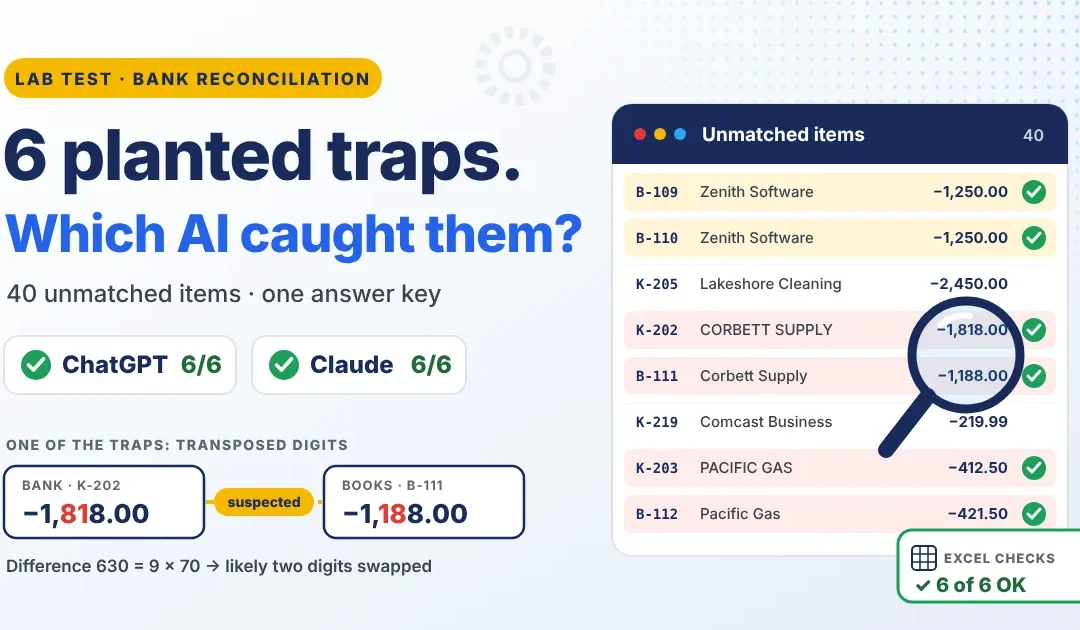
We gave ChatGPT and Claude the same fictional bank file with a known answer key. Both caught all 6 planted traps and marked nothing as cleared.
| Check | ChatGPT | Claude |
|---|---|---|
| Duplicate payment (B-109 / B-110) | ✓ Flagged | ✓ Flagged |
| Transposed digits (K-202 / B-111) | ✓ Found | ✓ Found |
| Transposed digits (K-203 / B-112) | ✓ Found | ✓ Found |
| Transposed digits (K-215 / B-118) | ✓ Found | ✓ Found |
| One digit wrong (K-204 / B-113) | ✓ Found | ✓ Found |
| Look-alike pair, different payee (K-205 / B-114) | ✓ Not paired, warned | ✓ Not paired, warned |
| Excel completeness checks | ✓ 6 of 6 OK | ✓ 6 of 6 OK |
| Score | 6 / 6 | 6 / 6 |
What we did
Prompt 1 (grouping):
Propose a group for each of these unmatched items: outstanding check, deposit in transit, timing (same item, dates differ), possible duplicate, amount mismatch, no counterpart. These are proposals for a person to confirm. Keep the original ID and do not mark anything as cleared. Return a table with columns ID, Source, Date, Description, Amount, Proposed group.

Prompt 2 (near-match):
Compare bank and books items with the same or similar payee. A bank line that says only DEPOSIT may pair with a books deposit on the same date. Working in cents, list pairs where the amounts differ by a multiple of 9 or in exactly one digit. Label each pair "suspected", never "matched".
The evidence
Both tools got the same file and the same two prompts in a fresh chat. Screenshots are the tools’ own output, unedited.
Prompt 2: the suspected pairs
Both tools listed the same 4 pairs: three transposed-digit pairs (each difference is a multiple of 9) and one pair where a single digit is wrong. Both labelled every pair “suspected”. Neither called a pair matched.


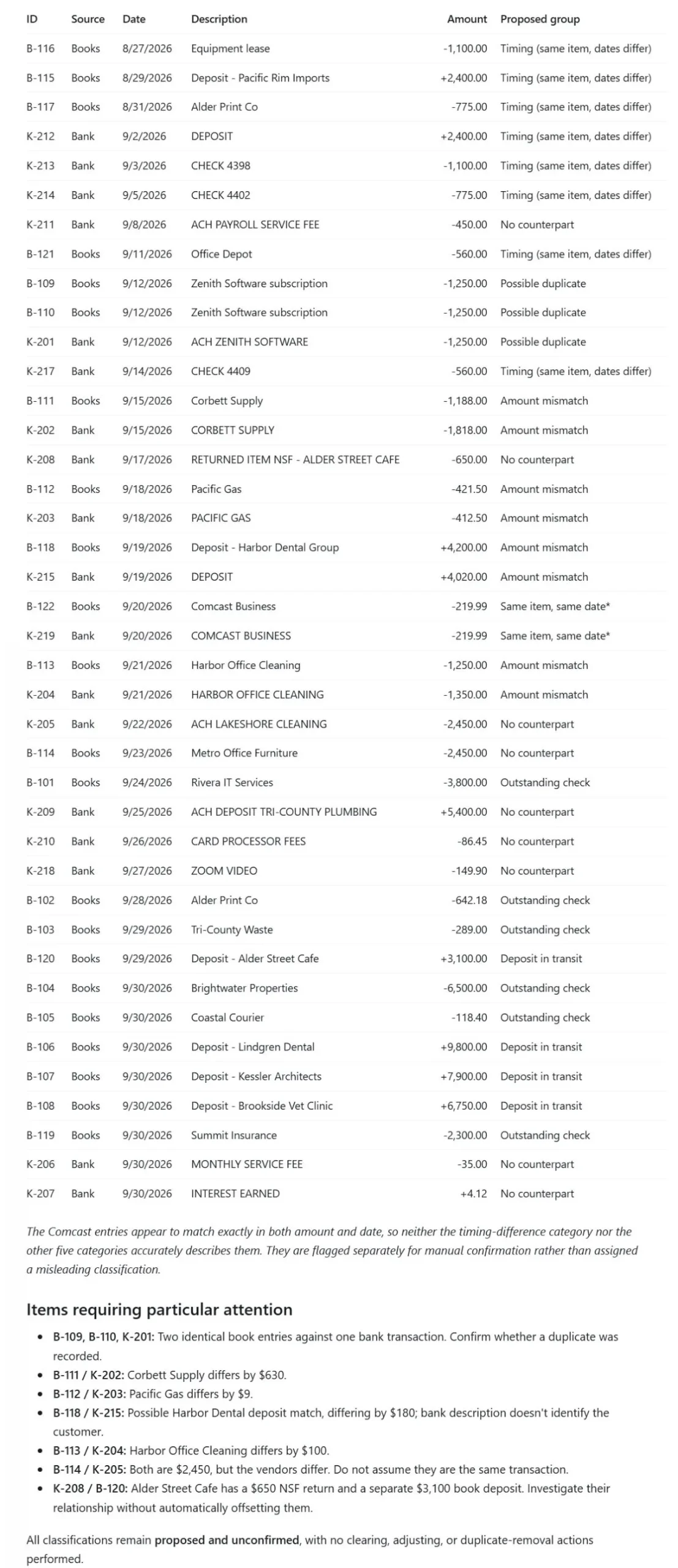
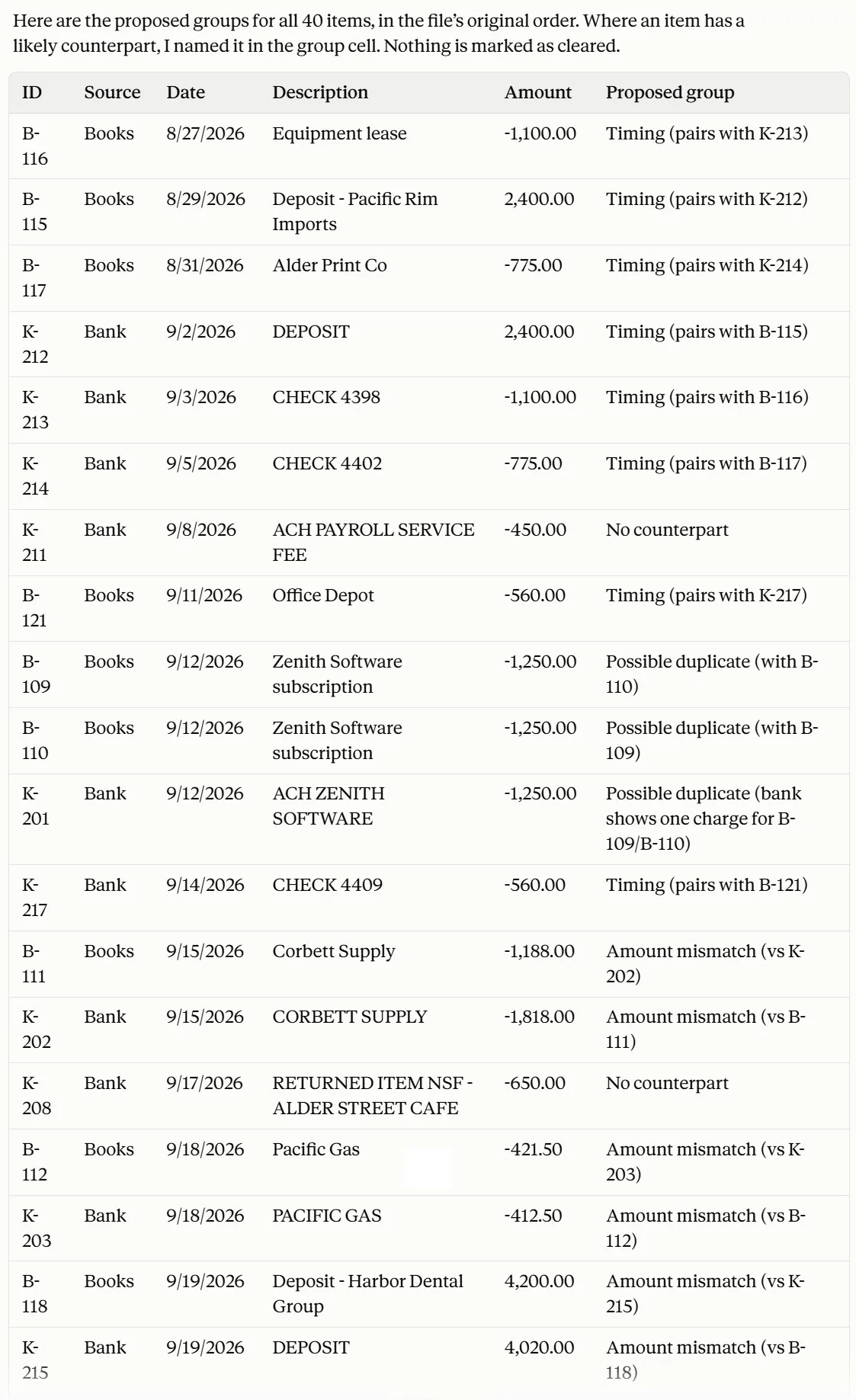
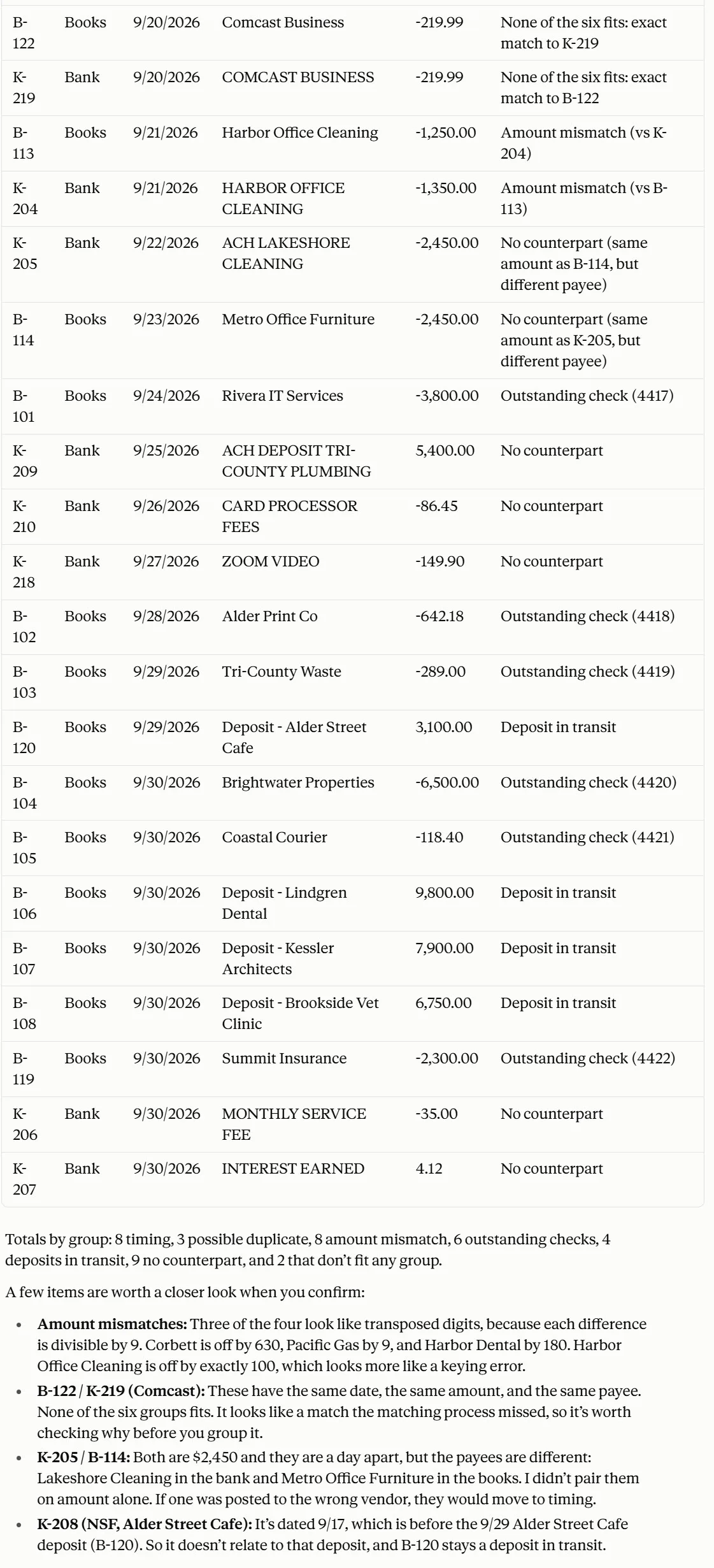
Prompt 1: the grouped table
Both returned all 40 items with their original IDs and amounts, flagged the duplicate Zenith entry, and left the look-alike pair (K-205 Lakeshore Cleaning and B-114 Metro Office Furniture, both $2,450) unmatched with a warning. Claude also named the counterpart for each row.
The Excel check
Each table was pasted into the check workbook. Both passed all six checks: same count, same signed total, no missing, repeated or extra IDs, and no changed amounts. The checks only prove nothing was lost or altered. They do not prove the groups are right.

Neither tool missed a planted trap.
Both broke one instruction. The prompt allowed six groups, and both put the Comcast pair (B-122 / K-219) in a group of their own because the date, amount and payee match exactly. That was a reasonable call for a match the auto-match missed, but it shows the output still needs a person.
ChatGPT's grouped table did not say which items belong together. You have to read the notes under the table to work it out. Claude named the counterpart on every row.
On a 40-item list, either tool gave a usable first pass at grouping unmatched items and spotting typing errors.
Ask for the original ID on every row and for "suspected" labels, then paste the result into a check workbook. Both tools kept to those rules, and that is what makes the output checkable.
Neither result is a finished reconciliation. A person still confirms each item against the source documents.
Method, limits and reruns
Question: Can the AI match 40 unmatched bank items without inventing a match? · Data: Fictional September 2026 export: 40 unmatched bank and books items, 6 planted traps, answer key built before testing. Same file as the reconciliation check workbook. · Runs: 1 run per tool, fresh chat
One fictional file of 40 items and one run per tool on October 23, 2026. Results can change when the tools update, so this test is dated and will be rerun.
Not tested: real bank exports, larger files, other accounting systems' export formats, or whether the proposed groups would hold up against source documents.
| Tool | Plan | Mode | Version |
|---|---|---|---|
| ChatGPT | Plus | Regular chat, CSV attached | Oct 23, 2026 |
| Claude | Pro | Regular chat, CSV attached | Oct 23, 2026 |
| Run date | Plan and mode | Change |
|---|---|---|
| Oct 23, 2026 | ChatGPT Plus, Claude Pro | First run |